-
-
SolutionGoman Lift provides spider lifts, insulated bucket trucks and scissor lifts for power, commercial, transit and municipal aerial operations. Our project cases cover airports, high-speed stations, malls and substations with 500+ global clients.
-
-
ProductGoman Lift manufactures full series aerial work platforms, including tracked spider lifts, articulating boom lifts, telescopic lifts, insulated tracked lifts for live-line power maintenance, scissor lifts and trailer-mounted lifts. Factory direct supply.
-
BlogGOMAN LIFT News Center focuses on sharing professional expertise about aerial work equipment, publishing product comparisons, performance analysis and working condition selection guides for spider lifts, Insulated Tracked Lifts, articulated & telescopic boom lifts and Scissor Lifts. It also features the latest GOMAN LIFT corporate updates, project delivery cases and cutting-edge industry trends.
-
RecruitIt is our consistent talent development philosophy to grow and progress together with employees. Adhering to people-oriented management, we unite staff with promising career prospects and ambitious goals. We uphold equality for all and care for every talent.
Consultation Hotline
Spider Lift vs Traditional Aerial Work Platforms: Core Differences, Pros & Job Site Use Cases
Time
2026-06-25
浏览量
256
If you’ve spent hours struggling to maneuver a regular boom lift inside a shopping mall, or watched a heavy wheeled aerial machine sink into soft lawn on a residential tree trimming job, you’ve probably questioned whether a spider lift would’ve saved you major time and money.
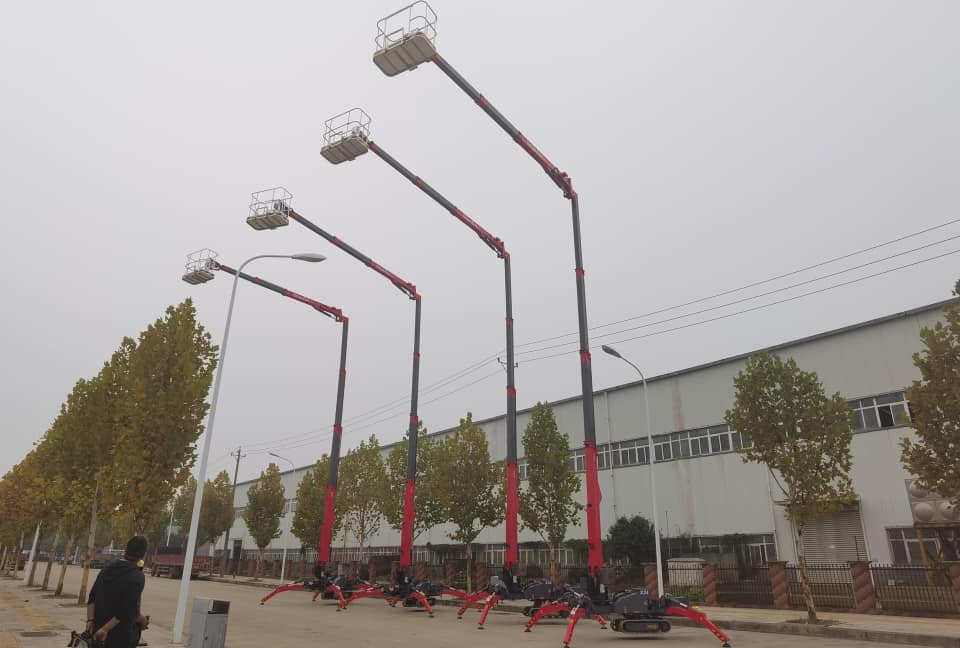
Most construction crews only shop lifts by maximum working height, ignoring dozens of design gaps that change everything from site setup speed to hidden repair fees for damaged floors or landscaping. Traditional aerial work platforms cover wheeled scissor lifts, straight telescopic booms and standard articulated booms — the heavy, wide-base machines you’ll spot on nearly every large ground-up construction site. Spider lifts, also known as compact crawler lifts, use narrow foldable frames, non-marking rubber tracks and four separate hydraulic outriggers that give them unmatched stability on uneven ground.
After years supporting contractors, restoration teams and utility maintenance crews across Europe and North America, our equipment team has seen countless costly mistakes from mismatched lift choices. This guide draws on real on-site jobs to lay out every meaningful difference between these two machine types, no overly technical jargon included.
Chassis & On-Site Mobility – The Most Obvious Design Gap
How Traditional Wheeled Aerial Lifts Move Around Job Sites
Every standard boom and scissor lift sits on a rigid heavy steel wheeled undercarriage, built with open construction yards in mind.
Most mid-height 20m wheeled booms carry an overall width between 1.8m and 3.2m, even when folded down for transport. Their full foam or pneumatic tires create heavy ground pressure, with many models tipping the scales above 6,000kg. While rough-terrain variants come with four-wheel drive, they cannot climb shallow stairs or safely navigate steep uneven gradients.
A major pain point crews run into is turntable tail swing. When rotating the boom, the machine’s rear counterweight swings wide, demanding plenty of extra clearance in narrow alleys or tight building surrounds. Worse still, nearly all full-size traditional lifts cannot fit through standard single interior doorways without partial disassembly — a massive headache for indoor retail or office renovation work.
It’s worth noting lightweight compact booms under 15m are a slight exception here, weighing closer to 4,500kg, but they still carry the same wide footprint and tail swing drawbacks.
Compact Tracked Spider Lift Mobility Built For Tight Spaces
Spider lifts are engineered from the ground up to solve confined-space access issues regular lifts cannot touch. Once fully folded, many models shrink to just 0.78m to 0.95m wide, narrow enough to roll through standard internal doors, hotel corridors and small residential garden gates without taking any parts apart.
Their lightweight build is a game-changer too. A spider lift with the same 20m working height as a standard boom might weigh only 1,800 to 3,200kg — a fraction of the wheeled alternative. Flexible rubber tracks spread weight evenly across all surfaces, cutting ground pressure drastically and eliminating scuffs on tile, hardwood or delicate stone paving.
These crawler tracks can also climb gentle staircases and navigate slightly uneven ground, while the turntable boasts zero or minimal tail swing. For short-distance moves between local job sites, most spider lifts hook straight onto small trailers or half-ton pickup trucks, removing the need for expensive flatbed haulers.
Stability & Terrain Performance – Where Spider Lifts Pull Ahead
Terrain Limitations Of Standard Aerial Work Platforms
Traditional wheeled lifts only operate safely on perfectly flat, solid concrete or asphalt. Their factory-fitted outriggers have a narrow leveling range, and most cannot safely compensate for slopes steeper than 5 to 8 degrees.
Bring one onto soft grass, mud or loose gravel, and the heavy chassis will sink quickly, creating a serious tipping risk that site safety inspectors will flag immediately. For indoor projects with expensive finished flooring, heavy wheels leave permanent scratches, and thin heritage paving slabs often crack under their weight. These machines also cannot safely deploy on tiered rooftop patios or stepped landscaping.
Rough-terrain booms handle mild uneven ground better than indoor electric scissor lifts, but they still fail on steep, multi-level sites.
Independent Adjustable Outriggers Make Spider Lifts Terrain-Friendly
The four separate hydraulic outriggers — the “spider legs” that give these machines their name — are their biggest competitive advantage. Each leg adjusts up and down independently, letting operators level the full machine on slopes reaching 20 to 25 degrees, plus uneven rock, garden steps and tiered landscaping beds.
Low ground pressure from the tracked chassis means crews can operate on manicured lawns without leaving ruts or dead grass, a huge win for arborists and historic property restoration teams. Outriggers extend symmetrically to spread weight evenly, so operators can safely set up on suspended mezzanine floors and fragile heritage stone surfaces without risk of damage.
Best of all, the full leg adjustment system works via wireless remote control before lifting the boom off the ground, cutting down setup-related safety hazards on unpredictable terrain.
Indoor Work Capabilities For Renovation & Facility Maintenance
Why Traditional Lifts Struggle Inside Buildings
Standard aerial lifts rarely make sense for interior jobs like mall maintenance, hospital corridor repairs or museum restoration. Their wide base blocks narrow walkways, and their heavy weight often exceeds floor load limits in older buildings or suspended ceiling structures.
Even if you spring for non-marking wheel upgrades, large tires still risk scraping glass partitions, retail display fixtures and polished marble floors. The large tail swing also creates constant collision risks when working close to walls inside crowded commercial spaces. Diesel-powered traditional booms are completely unsuitable indoors, as exhaust fumes require costly ventilation permits and extraction systems.
Spider Lifts Designed For Mixed Indoor & Outdoor Use
Manufacturers build compact crawler spider lifts specifically to handle indoor and outdoor work on the same project. Most units feature bi-energy power setups: battery electric mode for quiet, zero-emission indoor operation, with a low-emission diesel backup for off-grid outdoor sites without power access.
The slim folded frame rolls through door frames and passenger elevators without disassembly, and their lighter weight meets strict floor load ratings for historic churches, art galleries and high-rise office fit-outs. Wireless remote drive lets operators steer the machine around tight corners without standing under an elevated boom section, adding an extra layer of on-site safety.
Boom Reach & Obstacle Navigation Differences
Reach Restrictions On Conventional Boom & Scissor Lifts
Scissor lifts only offer pure vertical lift with zero horizontal outreach, making them useless for working over roof ridges, tree canopies or exterior wall overhangs. Straight telescopic booms deliver long horizontal reach but lack multi-joint articulation, so they cannot wrap around overhead ductwork, support beams or thick tree trunks.
Standard articulated wheeled booms do have jointed arms, but their wide chassis means you cannot park the machine tight against building facades or squeeze into narrow gaps between structures.
Dual Articulated-Telescopic Boom On Spider Lifts
Nearly all medium and high-reach spider lifts combine knuckle articulation and telescopic extension in one boom arm. The multi-jointed design bends up, out and backward to reach over walls, roof peaks, overhead HVAC piping and dense tree branches that regular lifts cannot access.
The turntable sits low to the ground, letting workers position the lift basket into tight overhead gaps inaccessible to wheeled aerial equipment. An optional jib arm adds precise fine movement for delicate tasks like window caulking, light fixture installation and curtain wall repair. Working height options stretch from 10m all the way up to 48m, matching or beating the maximum reach of most mid-size traditional boom lifts.
Transport, Running Costs & Daily Operation Efficiency
Hidden Expenses That Come With Traditional Aerial Lifts
Virtually all full-size wheeled boom lifts require heavy flatbed trucks for delivery between job sites, which adds significant hauling surcharges to every rental bill. Large diesel engines run loud and produce strong exhaust, limiting indoor usability without extra ventilation equipment.
Their heavy curb weight pushes up fuel costs for cross-city transport, and crews must reposition the entire machine base horizontally every time they need to shift the basket to a new work zone. This constant repositioning eats up hours of productive work time each day on complex sites.
Lower Overhead For Spider Lift Transport & Operation
Lightweight spider lift models tow easily behind small trailers or half-ton pickup trucks, completely removing flatbed delivery fees for local jobs. The dual power setup delivers silent battery operation indoors, while low-emission diesel cuts fume issues for outdoor residential work.
Once the four outriggers lock the chassis in place, operators reposition the basket entirely through boom articulation — no need to drive the whole machine forward or backward multiple times a day. Small fuel tanks and lighter overall weight also lower daily fuel and routine maintenance costs for long-term rental fleets.
Previous:What Is Aerial Spider Lift
Recommended News

Address : 188 Doubu Avenue, Hannan District, Wuhan 430090,China
Jack: 0086 18627769149(wechat/whatsApp)
Fendi: 0086 13339994983(wechat/whatsApp)
Chole: 0086 13886057623(wechat/whatsApp)
Ellen: 0086 13627238296 (wechat)
Tel: 0086 27 8485 5127
Fax : 0086 27 8485 5128
Email : sales@gomanlift.com